The Church of Our Savior on the Spilled Blood
This marvelous Russian-style church was built on the spot where Emperor Alexander II was assassinated in March 1881. After assuming power in 1855 in the wake of Russia's disastrous defeat in the Crimean war against Britain, France and Turkey, Alexander II initiated a number of reforms. In 1861 he freed the Russian serfs (peasants, who were almost enslaved to their owners) from their ties to their masters and undertook a rigorous program of military, judicial and urban reforms, never before attempted in Russia. However, during the second half of his reign Alexander II grew wary of the dangers of his system of reforms, having only barely survived a series of attempts on his life, including an explosion in the Winter Palace and the derailment of a train. Alexander II was finally assassinated in 1881 by a group of revolutionaries, who threw a bomb at his royal carriage.
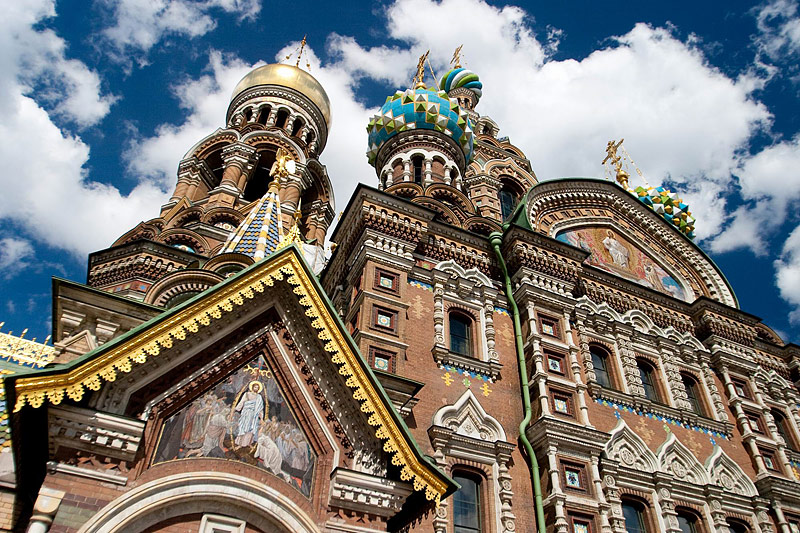
The decision was taken to build a church on the spot where the Emperor was mortally wounded. The church was built between 1883 and 1907 and was officially called the Resurrection of Christ Church (a.k.a. The Church of Our Savior on Spilled Blood ). The construction of the church was almost entirely funded by the Imperial family and thousands of private donators. Both the interior and exterior of the church is decorated with incredibly detailed mosaics, designed and created by the most prominent Russian artists of the day (V.M. Vasnetsov, M.V. Nesterov and M.A. Vrubel). Interestingly, despite the church's very obviously Russian aspect, its principle architect, A. Parland, was not even Russian by birth.
The church was closed for services in the 1930s, when the Bolsheviks went on an offensive against religion and destroyed churches all over the country. It remained closed and under restoration for over 30 years and was finally re-opened in 1997 in all its dazzling former glory. The view of the church from Nevsky Prospekt is absolutely breathtaking.
NOTE: Translations of the church's name vary between guidebooks and include The Church of the Savior on Blood, The Resurrection Church and The Church of the Resurrection of Christ.
Location: Naberezhnaia Kanala Griboedova. Reopened in late August 1997 after almost 30 years of restoration.