St. Petersburg Trams
One can call St. Petersburg a "City of Trams" because it has more trams than any other city in the world. Tram stops are marked with signs above the tracks (with a letter "T" on them).
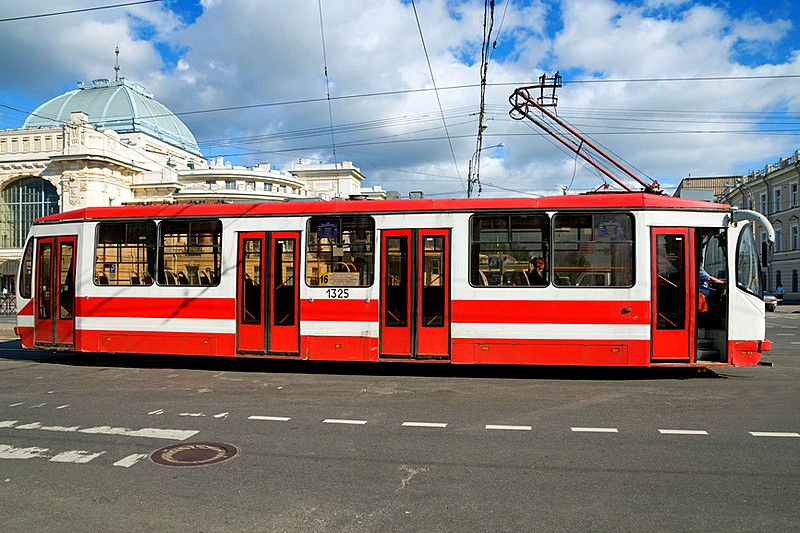
Tram in front of the Vitebsk Railway Station
Since January 1998 all trams have conductors on board. You should pay in cash to a conductor, unless you have a monthly pass. Conductors normally wear special uniform (and/or red arm bands). They check whether everybody has paid and sell tickets to those who need them. Don't be surprised to see an occasional kontrolyor - inspector, who might ask you to show your ticket.
The first tram to be seen in St. Petersburg was built and tested by engineer Fiodor A. Pirotskiy in 1880 (In St. Petersburg we claim that Pirotskiy invented trams and Siemens just marketed his idea). Horse-driven cars - called konka - had been running in St. Petersburg since 1862. By 1906 there were 150 km (93.8 miles) of track in the city and the konka carried 106 million passengers a year. Not surprisingly, konka owners fiercely opposed the introduction of electric trams in St. Petersburg. Regular tram services started on September 16, 1907. The trams were popular and soon drove the konka off the streets. By 1917 the city's tram system operated 710 tram cars, most of which ran all through the hard days of the Revolution and the Civil War.
During the Soviet days Leningrad became the city with the largest tram network in the world. The tram services were halted only briefly in December 1941 - April 1942 - the most terrible winter of the 900-day Siege of Leningrad.
By 1990 the city had 700 km (437.5 miles) of track and 2 200 tram cars. In 1990 alone the trams carried 950 million passengers.